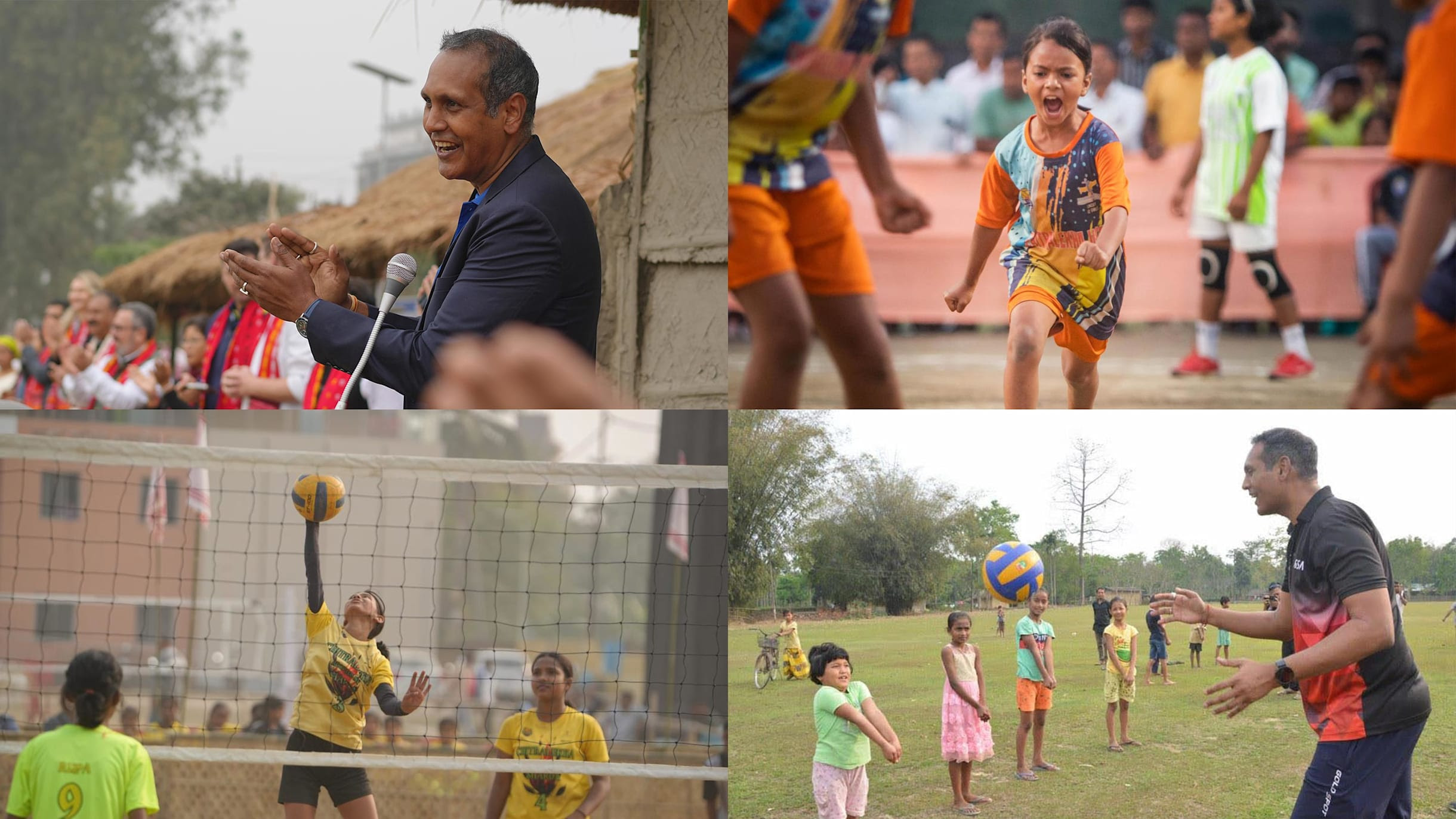
"VAN" (Sports Desk - 10.03.2026) :: Abhijit Bhattacharya, a former captain of the Indian men’s national volleyball team, has been named the Global Winner of the 2025 International Olympic Committee (IOC) Gender Equality, Diversity and Inclusion (GEDI) Champions Award for his impactful grassroots initiatives in rural India, ensuring equal access and visibility for girls and boys in sport.
Alongside the global award, five continental winners have also been recognised:
Africa: Racheal Kundananji, Zambia
Americas: Mónica Elvira Franco Luzcando, Panama
Asia: Kim Yeon-koung OLY, South Korea
Europe: Michele Kang, France
Oceania: Robyn Cockburn, New Zealand
Expanding access to sport in rural communities
Following his elite sporting career, the 2025 Global Winner, Bhattacharya, launched large-scale, inclusive grassroots sports programmes for children in rural and underserved communities in Assam, in northeastern India.
The Assam Volleyball Mission 100 (AVM100) and the Brahmaputra Volleyball League (BVL), which he founded and developed, now reach over 12,000 children across 400 teams. Through these initiatives, Bhattacharya championed gender equality and social development by ensuring equal participation for girls and boys and bringing sport directly into villages, removing barriers and strengthening community support.
The success of his initiatives demonstrates how sport can empower young people, particularly girls, by building confidence, unlocking opportunities and developing leadership pathways for women within volleyball.
"Representing India in winning this award, and most importantly representing the villages of Assam, makes me deeply emotional,” said Bhattacharya. “I don’t see it solely as a recognition of my work, but as a tribute to every volunteer, every parent who allowed their daughter to step out and play, and every young girl who believed in herself enough to know that she belonged on a volleyball court. This award tells the community of Assam that their small village matters and that their work matters.”
“Assam is a region that is often under-represented in national sport development, but receiving this award highlights how even a grassroots movement can have a significantly positive impact in the lives of many. I hope this inspires many more individuals and organisations in our community and throughout the world to come together to advance gender equality and drive change through sport."
Launched in 2020, the BVL has grown into one of the largest community-based grassroots leagues in the world. It grew out of the AVM100 initiative, created by Bhattacharya in 2019, which aimed to distribute 100 volleyballs to villages. This later expanded into 100 village clubs and the creation of the league. Each participating village registers equal teams for girls and boys in several age categories (under-12s and under-16s), with matches held locally to keep participation accessible.
For many girls in rural communities, these opportunities represent their first chance to participate in organised sport and to travel outside their village.
Promoting gender equality through volleyball
Promoting gender equality in sport sits at the heart of the BVL. The league encourages girls' participation not only by providing equal playing opportunities, but also by ensuring equal visibility.
More than 750 matches are broadcast each season without gender distinction, while local youth – girls and boys – are actively involved in match production, live streaming and digital storytelling. These initiatives provide valuable skills and leadership experience, expanding opportunities beyond the field of play.
Through a UNICEF-supported programme, the BVL has also trained 45 girls and 45 boys as community ambassadors, empowering them to advocate for gender equality, education and social responsibility within their communities.
“On the court, the girls are making history by representing Assam for the first time ever in the quarterfinals of the Junior National Championship,” says Bhattacharya. “Off the court, they are becoming ambassadors for child rights and climate resilience – speaking publicly and advocating for their rights.”
Ensuring safe and supportive environments for young female athletes is another key priority for Bhattacharya and his team. Male and female coaches have been trained to address gender-specific barriers in sport with sensitivity and understanding. These measures have helped reduce dropout rates among adolescent girls and created more inclusive sporting environments.
“We can leverage the inherent qualities of volleyball around teamwork and communication to teach important life skills,” added Bhattacharya. “We are constantly working to creating environments where girls can participate safely and confidently through safeguarding frameworks, menstrual hygiene awareness programmes and trained grassroots coaches.”
Creating pathways for women in sport
Bhattacharya has also focused on developing leadership pathways for women in volleyball.
Former BVL players are encouraged to become coaches, referees and technical officials, ensuring women continue to play a role within the league.
One example is a coaching course delivered in Assam with support from the FIVB Volleyball Foundation, which enabled 45 community coaches – with a strong emphasis on women and individuals from remote areas – to gain internationally recognised qualifications.
Responses
Leave your comment