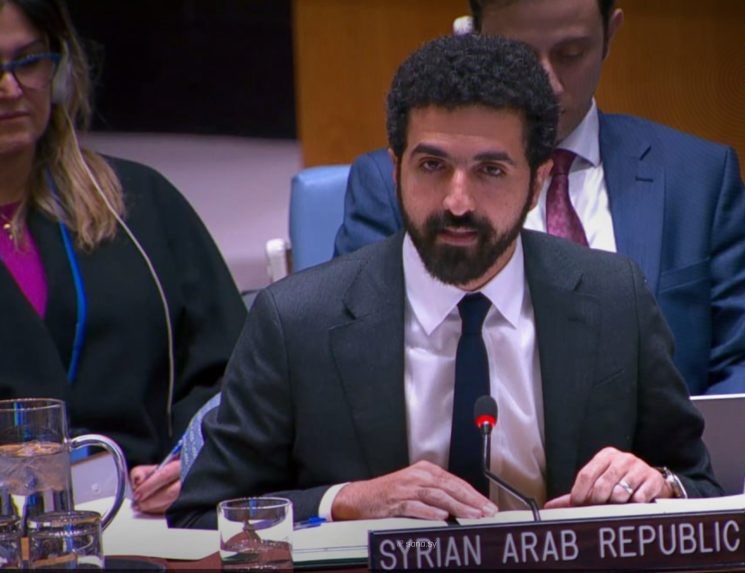
"VAN" (International Desk - 09.01.2026) :: Syria’s Permanent Representative to the United Nations, Ambassador Ibrahim Olabi, stressed on Thursday that Syria looks forward to international support in eliminating the heavy legacy of chemical weapons inherited from the deposed regime.
He reaffirmed Syria’s firm determination to close this chapter once and for all, underscoring its commitment to safeguarding and strengthening the global non-proliferation regime as a cornerstone of regional and international peace and security.
“I thank Deputy High Representative for Disarmament Affairs Adi Ebo for his briefing, and for not associating Syria’s name with the chemical weapons program, emphasizing instead that this program belonged to the era of the defunct Assad regime, and that any incomplete declarations stemmed from that period.” Ambassador Olabi said in a statement during a UN Security Council session on the Middle East,
He added: “On December 8, Syria marked one year since its liberation from the dark era of the deposed Assad regime, during which chemical weapons were widely used against civilians. Today, I approach the chemical file from the perspective of Syria’s new policies adopted over the past year. Our efforts since the Director-General’s visit ten months ago provide a tangible example of our approach throughout the year, successfully moving the file from a stage of doubt and manipulation to one of partnership with the Organization.”
Olabi continued: “The Syrian government’s approach to confronting the legacy of the deposed regime is to bravely address any heavy burden from that era. The chemical file is a prime example of such inherited issues, of which we were victims. We have dealt with it effectively despite major challenges, including the secrecy of defunct Assad’s chemical program, the lack of institutional memory, weak national capacities, and the dangers posed by landmines and remnants of war.”
“What further complicates this picture is the destructive role played by Israel through targeting suspected sites. This makes handling the file highly unusual, but we rose to the challenge and assumed responsibility.” Olabi stated.
He added: “This year, the Syrian government sought to be a source of security both locally and internationally. We risked our lives to eliminate remnants of chemical weapons in order to protect Syrians and safeguard regional security, while adhering to the highest possible safety standards given our limited resources, despite the risks posed to national teams.”
“From the very beginning, the Syrian government worked to move beyond the procrastination and manipulation that characterized the previous stage in implementing international agreements and legal obligations. We were keen to fully honor our commitments, out of respect for our international responsibilities.” Olabi continued.
He said: “Regarding the chemical file, Syria’s commitment was demonstrated by providing all necessary facilities to OPCW technical teams, including issuing entry visas for all members, facilitating their access to Syrian territory, and granting permits for eight deployment missions, during which 23 sites were visited.”
He added: “During these visits, unrestricted access was granted, along with full logistical and security support. We are currently witnessing the longest deployment of OPCW teams, which began on October 6 and continues to this day, marking the start of a lasting presence of the Organization in Syria. In parallel, Syria has consistently submitted its monthly national reports to the Organization.”
Olabi affirmed that the new Syria believes in cooperation and partnership with the international community, and in multilateralism as a means to overcome disputes and build mutual relations based on trust and respect. Guided by this conviction, Syria has achieved a qualitative shift in its cooperation with the Organization for the Prohibition of Chemical Weapons (OPCW), reflected in the decisions of the organization’s Executive Council and evident in the change of positions expressed by states today.
He explained: “This was recently crowned by the adoption of a UN General Assembly resolution on implementing the chemical weapons ban at the beginning of December, with broad support from member states. This constituted a clear political message of international backing for the new trajectory of relations between Syria and the OPCW.”
Syria’s Permanent Representative to the UN noted that in this positive climate, Syria opened its doors without reservation to international cooperation. The results of national teams’ work have begun to emerge, as they identified two sites containing empty cylinders previously used for toxic chemicals. Immediate communication was made with the OPCW Technical Secretariat, and national teams continue their efforts to locate and report other suspected sites.
Olabi added that Syria provided the Technical Secretariat with 6,000 documents related to the inherited chemical program and facilitated interviews with 14 witnesses, including individuals who had worked on the program during the deposed Assad era.
He emphasized that the new Syria has placed transitional justice at the forefront of its priorities, believing in the need to hold perpetrators accountable, provide redress to victims, and ensure non-repetition. This, he said, is a fundamental pillar for consolidating civil peace and strengthening social stability.
Cr - SANA
Responses
Leave your comment