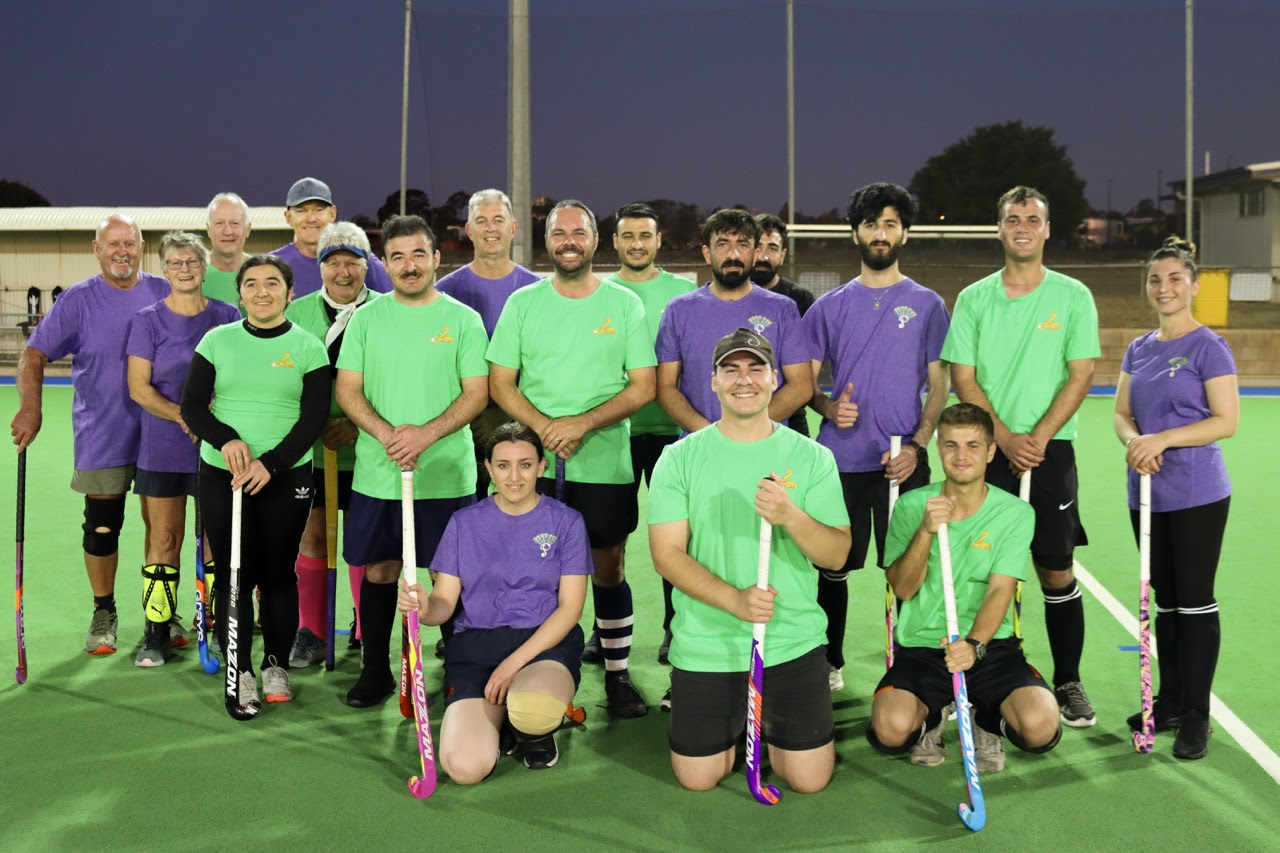
"VAN" (Sports Desk - 01.04.2026) :: In Toowoomba, a regional city in Queensland, Australia, hockey is doing far more than developing athletes — it is helping rebuild lives.
At the centre of this transformation is the Toowoomba Hockey Association and their hockey manager, Jessie McCartney. Through the “Belong in Hockey” initiative, McCartney and his team are supporting Yazidi refugees — many of whom have fled genocide, displacement and trauma — to rediscover connection, confidence and opportunity through sport.
A simple idea with powerful potential
The programme began just over three years ago, when Jessie met Liz Levity, a volunteer at the association who also works with Multicultural Australia, the country’s refugee settlement agency.
Toowoomba is home to around 6,000 Yazidi refugees, alongside communities from Sudan and South Sudan. Many Yazidi families arrived from Northern Iraq and Syria after experiencing extreme hardship, often facing language barriers and, in some cases, having no written language at all.
“We started talking about how hockey could bring a lot of benefits together,” McCartney explains. “Physical health, mental wellbeing, social connection, language practice, role models — all in one place.”
The idea was straightforward: create a safe, welcoming space where refugees could connect with the local community through hockey. Turning that idea into reality, however, required persistence.
Building trust — one step at a time
The first sessions drew no participants.
“We had volunteers ready, sessions planned… and nobody showed up,” McCartney recalls.
It soon became clear that the issue wasn’t a lack of interest, but a lack of access and familiarity. So the team shifted their approach, taking hockey directly to where the refugees already were.
They began running sessions at a local TAFE college, where many refugees attended English classes. The response was immediate, with around 60 people participating in a single day. The next challenge, however, was encouraging them to transition into the hockey environment itself.
That breakthrough came through something simple but powerful: transport.
Volunteers began collecting participants from their homes and bringing them to sessions. “That’s how it started,” McCartney says. “Just picking people up and bringing them along.”
Creating a pathway to participation
Recognising that jumping straight into club hockey could feel overwhelming, the association introduced a structured pathway.
A key step is a social “summer sixes” competition — a six-a-side, half-field format involving around 450 players from across the community. Teams are intentionally mixed, combining refugees with local volunteers to create a supportive and inclusive environment.
The impact has been significant. In the programme’s first year, 20 refugees took part, with seven progressing into club hockey. The following year, participation grew to 30, and 13 moved into formal competition. Since then, both participation and broader social outcomes have continued to increase.
“We’ve had days where attendance dropped because participants were at job interviews,” McCartney notes. “That’s exactly what we want — their English improves, their confidence grows, and their networks expand. Hockey becomes a stepping stone.”
The power of volunteers
At the heart of the programme are its volunteers — a diverse group ranging from retirees to young players — whose impact extends far beyond coaching.
“They create interactions everywhere,” McCartney says. “On the car ride, on the pitch, over morning tea afterwards — it’s constant language practice and relationship building.”
These relationships often carry into everyday life. Volunteers have supported participants in learning to drive, preparing for job opportunities, sourcing essential household items, and navigating life in a new country. Over time, many of these connections become deeply personal.
“They almost become like grandparents or surrogate parents,” McCartney explains. “It all happens naturally.”
Changing perceptions — on and off the field
The programme has also played a powerful role in shifting cultural perceptions.
By intentionally involving strong female players as volunteers, the initiative challenges traditional gender norms. “Straight away, the men see women in leadership roles — coaching, guiding, performing,” McCartney says. “It changes the dynamic immediately.”
Hockey itself also helps level the playing field. Unlike more familiar sports such as football or cricket, where existing hierarchies can shape participation, hockey is new to most participants.
“Everyone starts as a beginner,” McCartney explains. “It removes ego and competition, and creates space for inclusion — across gender, age and ability.”
As a result, the programme has achieved near equal participation between men and women — something that initially seemed unlikely.
A model for broader inclusion
Building on its success, the Toowoomba Hockey Association is now exploring ways to expand the initiative further. Future plans include engaging people with intellectual disabilities through para hockey, reaching Indigenous communities in rural Australia, supporting military veterans, and welcoming other refugee groups beyond the Yazidi community.
The vision is clear: to create inclusive hockey environments that not only encourage participation but also open pathways into volunteering, coaching and officiating.
A message that resonates globally
For McCartney, the programme highlights the broader potential of sport as a force for change.
“Sport is the answer — but only if we open our doors,” she says. “It takes time, patience and kindness. But when communities engage, perspectives shift — and that impact spreads.”
What began as a local initiative is now contributing to a global movement, aligning with efforts such as the Sport for Refugees Coalition and reinforcing the growing recognition of sport as a powerful tool for social inclusion.
More than a game
In Toowoomba, hockey is no longer just about competition.
It is about belonging.
It is about connection across cultures.
It is about rebuilding confidence, identity and opportunity.
And above all, it is a reminder that meaningful change often starts small — with persistence, compassion, and something as simple as a ride to the field.
Responses
Leave your comment