"VAN" (Sports Desk - 20.08.2026) :: The 7.4 magnitude earthquake that struck Colombia on Monday, August 10, with tragic impacts in the departments of the Coffee Region, Valle del Cauca, and Chocó, has caused an unprecedented standstill in Colombian sport. After a week of uncertainty, Dimayor (the Colombian Professional Football League) officially announced the schedule for the reactivation of the professional tournaments (women's and men's). However, the effects of the catastrophe continue to manifest themselves in serious structural damage to venues in the western part of the country, the permanent closure of multi-sport facilities, and an intense logistical and psychological exodus among high-performance athletes.
Football will return on August 19: The Colombian Professional Football League (Dimayor) confirmed that men's professional football in Colombia will resume on Wednesday, August 19, 2026, with a phased plan to play the remaining matches after the mandatory break due to the national emergency. However, the situation remains delicate, and some road closures persist. Therefore, the league's directors are considering a proposal from its president, Carlos Mario Zuluaga, to replace the semifinal groups with direct elimination rounds (playoffs). This measure, which aims to mitigate the significant commercial losses and lack of ticket revenue from the postponed matches, would also restrictively reduce the number of final matches, impacting overall revenue from television rights and sponsorships. Meanwhile, the Women's Professional League will continue on Thursday, August 20, to determine the final teams that will qualify for the final phase, where Atlético Nacional, Deportivo Cali, and Millonarios have already secured their spots.
Cycling cuts back its competitions, other disciplines hit hard Sports goes far beyond football, and cycling is one of the disciplines most directly affected. Road restrictions forced the Colombian Cycling Federation to prematurely end the Tour of Colombia, on August 13th, declaring Diego Camargo the champion after only five stages. The initial decision was to continue the race, but complaints led to a reconsideration. Given the situation in the country, a forced break of up to two months in the national road cycling calendar is expected.
Meanwhile, the Colombian Weightlifting Federation, based in Cali, one of the hardest-hit cities, indefinitely canceled national selection trials due to the government's preventative closure of the High-Performance Training Center. In athletics, the decision to proceed with the National Senior Championships scheduled for August 21 in Bucaramanga sparked strong protests from delegations from the Valle del Cauca and the Coffee Region, severely affected areas. Land transport to the host city is impeded by the destruction of road infrastructure, with several sections in critical condition. A day before this article was published, it was announced that the National Federation would join the country in solidarity and that the new dates would be August 30 to November 1.
Structural damage to sports venues: The situation in the region is quite delicate, and several sports venues/stadiums across the country are in critical condition. Local authorities in each region have conducted inspections and found serious problems in some locations.
The Olympic Village - Hernán Ramírez Villegas Stadium (Pereira): Has the most critical damage, with cracks in internal walls, broken pipes, and shattered windows. As a result, the use of the stands is strictly restricted due to the risk of partial collapse. The Olympic swimming pool was also severely damaged, and the Colombian Swimming Federation suspended its use.
Palogrande Stadium (Manizales): Reported cracks in the underground irrigation system of the field and dislodged masonry. Additionally, the earthquake damaged the wiring of two lighting towers, temporarily rendering the stadium unusable.
Regional and private infrastructure: Severe cracks ruined the tennis courts at the Bolo Club in Armenia, leaving them totally unusable for players. In Cali, the Institute of Sports (Indervalle) offices sustained significant damage, forcing entities such as the Valle del Cauca Football League to switch to teleworking. Furthermore, Deportivo Cali's Pance headquarters temporarily closed its main buildings and gyms due to crackings.
Centenario Stadium (Armenia): It was confirmed that the "Garden of America" did not suffer serious structural damage and is approved as the first alternative stadium for the Once Caldas (Manizales) and Deportivo Pereira (Pereira) teams. Meanwhile, the Mayor's Office authorized the temporary use of the lot adjacent to the stadium as a free rubble disposal site.
Solidarity and Humanitarian Shelters: In the most affected areas, sports facilities have been repurposed. In Cali, the Jaime Aparicio Sports Complex has been transformed into a logistics hub for rescue workers; the Miguel Calero Hockey Coliseum is being used as a temporary shelter for families who have lost their homes; and the Miguel Chávez Baseball Diamond is operating as a massive collection center.
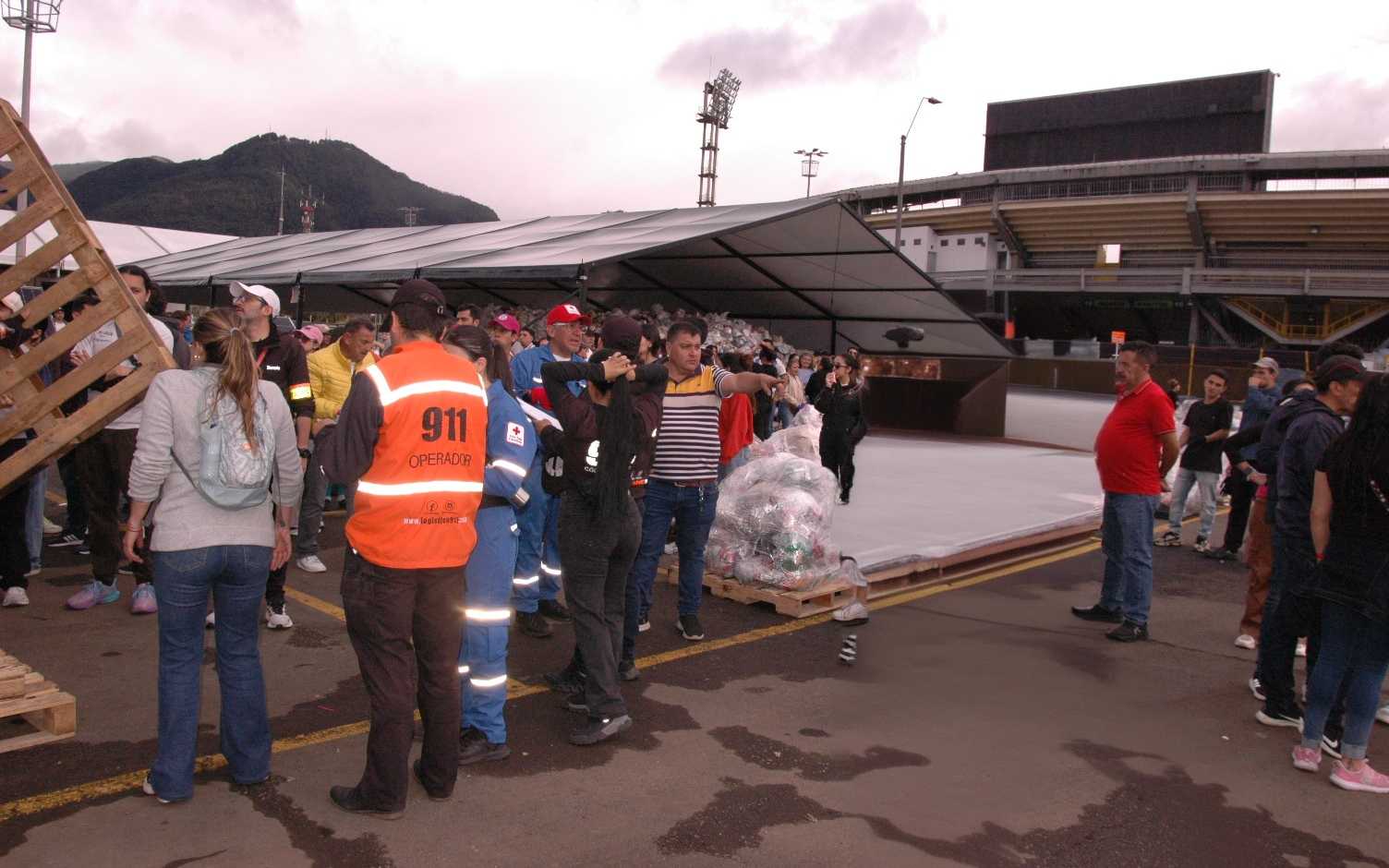
On the other hand, regions that were not physically affected are redirecting their resources toward humanitarian aid. Cities like Bogotá and Medellín temporarily suspended their activities. In Bogotá, El Campín Stadium and the Sports Palace were designated as donation collection points, functioning as the country's largest logistics and collection center in conjunction with the Red Cross to receive donations from citizens and businesses. In Medellín, Deportivo Independiente Medellín (DIM) opened its DIM Store located in the stadium as a collection center, and together with Atlético Nacional and the #VamosTodosJuntos initiative, they set up the Great Solidarity Tent in the stadium's plaza.
Sports united for earthquake victims: Several current and former players of the Colombian national football team, led by Mario Alberto Yepes and Radamel Falcao, announced a charity match in Bogotá (Friday, August 21) to raise funds for reconstruction. Similarly, the 36 professional football clubs in the A and B leagues, along with a joint contribution of one million dollars from CONMEBOL and the Colombian Football Federation (FCF), will allocate resources directly to help those affected in Chocó and southwestern Colombia.
Fan Aid: Millonarios Football Club supporters demonstrated their solidarity by collecting nearly 30 tons of donations to support the victims of the devastating earthquake. The initiative was led by the "Ambassador" Fan Commission and had the support of organized fan groups such as the Comandos Azules and the Tribuna Oriental. Collection centers were set up near El Campín Stadium and the Movistar Arena, where Andrés Llinás, a key defender for Millonarios, also joined the effort, directly participating in the organization and packing of supplies destined for the affected communities.
On the other hand, Independiente Santa Fe set up an aid collection center at ‘Casa Cardenal’, where tons of supplies were gathered under the leadership of players and directors. The club also announced that it will donate to those affected, a portion of the ticket sales from its Copa Sudamericana match against River Plate.
Clubs and fans of teams such as Águilas, Chicó, Cúcuta, Envigado, Fortaleza, Huila, Jaguares, Junior, Pasto, Patriotas, Real Cartagena, and Tolima, along with players like Luis Díaz, James Rodríguez, Jhon Arias, Jaminton Campaz, Jhon Córdoba, Juan Guillermo Cuadrado, Matheus Uribe, and Jhon Lucumí, among others, joined together to donate or support the collection of blankets, food, and personal hygiene items.
Regions that were not physically affected are redirecting their resources toward humanitarian aid. Cities like Bogotá and Medellín temporarily suspended their activities. In Bogotá, El Campín Stadium and the Sports Palace were designated as donation collection points, functioning as the country's largest logistics and collection center in conjunction with the Red Cross to receive donations from citizens and businesses. In Medellín, Deportivo Independiente Medellín (DIM) opened its DIM Store located in the stadium as a collection center, and together with Atlético Nacional and the #VamosTodosJuntos initiative, they set up the Great Solidarity Tent in the stadium's plaza.
Juan Pablo Montoya and his contribution: The motorsport race organized by Juan Pablo Montoya and his son Sebastián, initially called the Pony Malta Circuit 2026, took place on Sunday, August 16th, on the Malecón in Barranquilla. Following the earthquake, its focus shifted completely, becoming the 'Circuito Colombia,' a 100% charitable event. This avoided its cancellation due to the national mourning period, transforming it into one of the largest sources of private fundraising for the emergency. 100% of ticket sales will go towards disaster relief and home reconstruction. Additionally, the Malecón (boardwalk) has set up designated collection points for essential supplies and food, and an auction of Juan Pablo Montoya's international motorsport memorabilia was held to raise further funds.
Psychological Support: The earthquake not only damaged buildings and streets, but its most profound impact has been psychological. Given the significant emotional toll, the Ministry of Sport announced that it is already providing psychological support to more than 100 athletes from the Pacific region and the Coffee Region. Furthermore, swimming and athletics teams from Bogotá and Antioquia have opened their sports facilities to temporarily house elite athletes, such as Olympic swimmer Luis Felipe Uribe, ensuring they can continue their training for the South American Games in September.
The country is devastated, and at this moment the unity that sport generates is fundamental to move forward, to leave behind fear and dread, and to rise from the rubble.
Cr - AIPS
Responses
Leave your comment