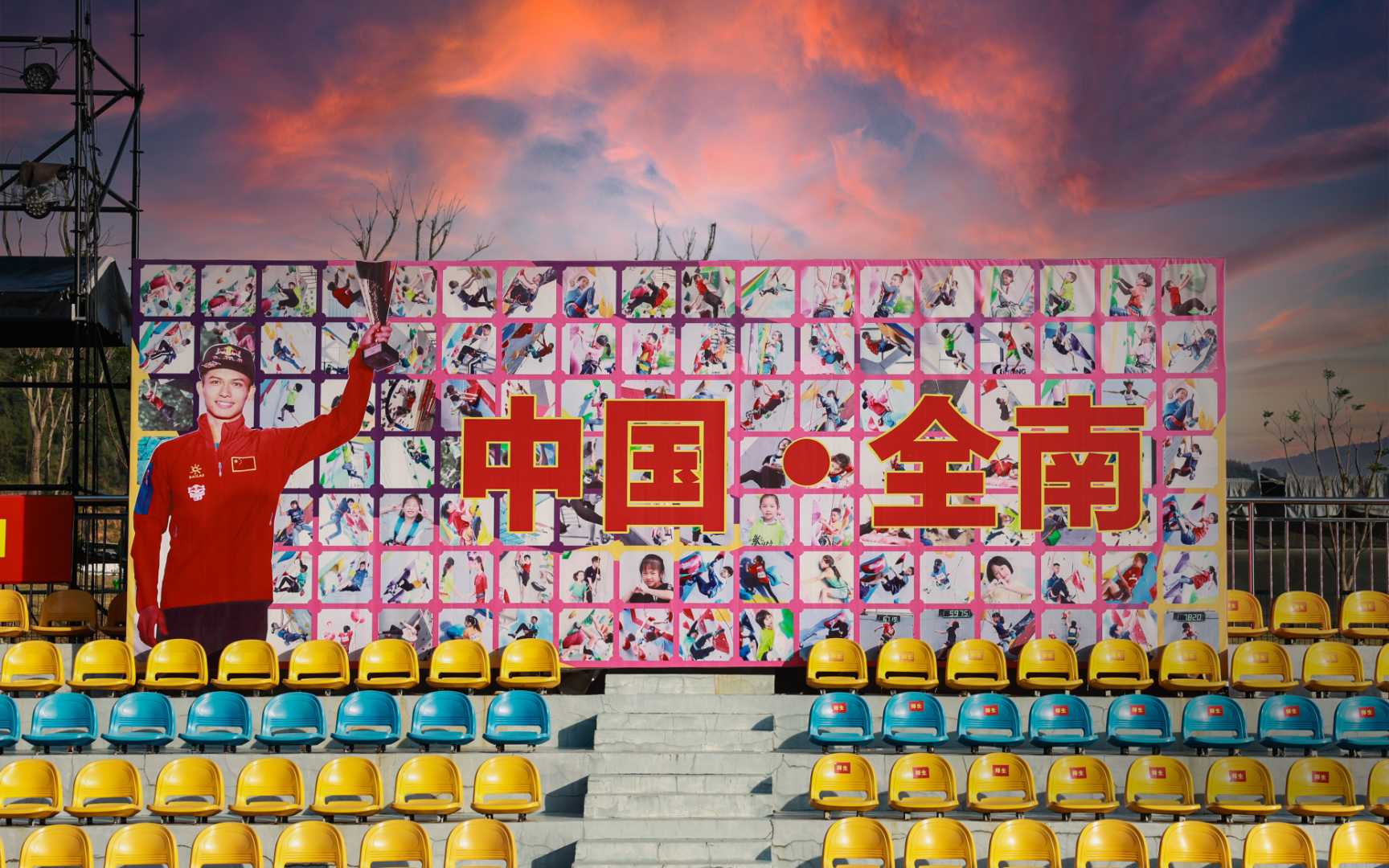
"VAN" (Sports Desk - 22.08.2026) :: On August 16, the four‑day World Climbing Asia Youth Series Quannan 2026 drew to a close in Quannan, a city in southern Jiangxi Province, China. For the 174 athletes from eight Asian countries and regions, this may be merely a memorable episode in their climbing careers, yet it marks a highly significant milestone for Asian climbing: Asia now boasts a brand‑new platform for young talents to showcase their abilities. Quannan, a small county with a total population of less than 170,000, has unexpectedly emerged as a fresh starting‑point for Asian climbing. More importantly, through the youthful, earnest faces of competing athletes, Quannan has borne witness to the quiet transformation unfolding across world sport climbing: a discipline originating in Europe, it will increasingly be shaped by outstanding Asian athletes in the years ahead.
The Zhong Qixin Effect
When the World Climbing Asian Council decided to host the first‑ever World Climbing Asia Youth Series in Quannan, nearly every participating delegation asked one question straight away: Where is Quannan?
Nurwijayanti, an Indonesian international judge who flew five hours and fifteen minutes from Jakarta to Guangzhou before travelling by coach to the Quannan Climbing Town, posed exactly the same question. What concerned stakeholders was not merely Quannan’s geographical location, but rather why this landmark debut edition of the Asian youth climbing competition had been assigned to the county.
Multiple perspectives can explain this choice, yet one name consistently comes to the fore: Zhong Qixin. In the history of world speed climbing, “Zhong Qixin” is an indelible figure. A five‑time World Champion and six‑time world‑record breaker, he is widely known across global climbing circles as “Speed Zhong”. Half of Nurwijayanti’s confusion was resolved upon learning Quannan was Zhong Qixin’s hometown. The rest was cleared when she arrived at Quannan Climbing Town. Spanning 860 mu(about 57.33 ha.), the complex features professional competition routes covering speed, lead and bouldering, alongside dedicated indoor training buildings and a climbing culture centre. Remarkably, the town is also a China national AAAA‑level scenic area set amid mountains and waters with pleasant surroundings. Even the competition’s ingredients are sourced locally from Yiheng Agricultural Industrial Park within the town; produce travels from field to table even in under one hour, guaranteeing exceptional freshness and flavour.
Crucially, Quannan Climbing Town has built solid event‑organising experience step‑by‑step since 2022, hosting the National Youth Climbing Contests, the National Climbing Champions Cup ,the National Climbing Championships and etc.Though the World Climbing Asia Youth Series Quannan 2026 represented Quannan’s first continental‑level competition, accumulated prior expertise paired with meticulous dedication delivered a hugely successful edition that left a deep impression on all teams. One team manager joked that such a high benchmark set by the inaugural event would pose a challenge for future host locations.
Yasmin Ghaztani, Vice‑President of the World Climbing Asian Council, spoke highly of Quannan’s organisational capacity: “It has been truly excellent. Everything ran smoothly with impeccable professionalism. Climbing competitions are usually held in large cities, so to pull off a three‑discipline competition for bouldering, lead and speed here in this small county is truly impressive. I must also highlight the stunning scenery — I spent almost the whole competition taking photographs. This event serves as a fantastic demonstration. It will inspire more youth climbing events across Asia and drive further development for Asian climbing.”
Quannan’s multi‑year calendar of climbing events stems from more than its status as Zhong Qixin’s hometown. By drawing spectators and tourists to the climbing town, the local government boosts the regional economy, enriches residents’ cultural life and advances climbing popularisation — a well‑rounded development strategy. Zhang Renfu, Secretary of the Quannan County Party Committee, shared revealing figures at the opening ceremony: youth climbing participation in Quannan has exceeded 60%. The emergence of new talents comparable to Zhong Qixin in the future would come as no surprise.
Asia Accelerates Its Catch‑Up
World Climbing Asia Youth Series featured U17 and U15 age groups. Compared with the established Asian Youth Championships, which host U19 and U17 categories, the newly‑introduced U15 division offers valuable insights into Asia’s long‑term talent pool. Across the six U15 title contests, the medal distribution stood at four golds for China, one for Japan and one for South Korea. In speed climbing specifically, Chinese athletes dominated outright: Chinese athletes occupied all top‑eight women’s positions and the top‑seven men’s positions.
Speed climbing has long been China’s strength. The current men’s world record of 4.54 seconds was set by 17‑year‑old Chinese athlete Zhao Yicheng this May. Notably, Chinese athletes are mounting strong challenges to traditionally‑dominant Japan within bouldering and lead climbing and have achieved competitive edges. This trend was also visible in U17 bouldering and lead events, where 15‑year‑old Chinese athlete Mu Zerun claimed two gold medals. Remaining level‑headed about his achievements, Mu commented: “Kazuki Nakata, the Japanese athlete who won gold at this July’s World Youth Championships, did not compete in Quannan. He will take part in the upcoming Asian Youth Championships, and I look forward to competing against him.”
Kazuki Nakata, double U17 bouldering and lead gold medallist at the World Youth Championships, is widely tipped as a future star. Historically, Japan has excelled in bouldering and lead, yet European athletes have held the upper hand at Olympic level. Of the six climbing Olympic gold medals awarded so far, European athletes have secured five. Nevertheless, the landscape has shifted noticeably within just two years. Asian athletes are growing increasingly competitive. Bold predictions can be made: at the Los Angeles Olympics in two years’ time, medal distribution will no longer be one‑sided, with Asian contenders poised for far greater opportunities.
Shifting power dynamics between European and Asian athletes can partly be observed in the 2026 competition results of Slovenia’s two‑time Olympic champion Janja Garnbret. The once‑near‑unbeatable star suffered successive defeats at the Keqiao and Wujiang World Climbing Series stops early in the new season, only reclaiming a lead‑discipline gold at the World Climbing Series Innsbruck 2026 in June.
Shinji Mizumura, Vice‑President of the World Climbing Asian Council, praised the U15 athletes’ performances at the World Climbing Asia Youth Series Quannan 2026: “Previously we lacked competitions for U15 athletes, limiting our full understanding of Asia’s talent base. Watching these youngsters compete has filled me with confidence for Asia’s global prospects. Their strong performances have deepened Asia’s talent reservoir, enabling us to mount more formidable challenges against European and North‑American athletes in lead and bouldering. Significant gaps once existed, yet these have narrowed substantially. Moving forward, Asia aims not only to catch up but potentially surpass traditional powerhouses.”
Japan’s Climbing Gyms
At the World Climbing Youth Championship held in Arco, Italy, from 18‑25 July 2026, China and Japan each claimed three gold medals to share top place on the medal table. South Korea took two golds, while Germany, Switzerland, Austria and New Zealand secured one apiece. Where the World Climbing Youth Championship illustrated Asia’s challenge to European dominance, the Asian Youth Cup showcased intra‑Asian competition, with Chinese athletes mounting pressure on Japan and demonstrating promising future potential.
For a long period, Japanese athletes held a decisive advantage over Chinese competitors in bouldering and lead, a gap still largely evident in senior‑level competitions. However, disparities are shrinking rapidly within youth categories, with several young Chinese athletes capable of challenging for supremacy. Stand‑outs include Li Meini, winner of back‑to‑back World Youth Championship bouldering golds in 2024 and 2025, and Mu Zerun, newly‑crowned bouldering and lead champion at the World Climbing Asia Youth Series Quannan 2026.
China’s youth‑athlete development has received strong impetus since climbing joined the Olympic programme. At the Paris 2024 Olympics, Wu Peng and Deng Lijuan claimed silver medals in men’s and women’s speed respectively. Their results raised public awareness of climbing nationwide and accelerated the sport’s domestic growth. Climbing gyms have mushroomed across megacities including Beijing, Shanghai, Guangzhou and Shenzhen, and are increasingly found in second‑ and third‑tier cities. Local authorities such as Quannan have also invested in hosting competitions to foster climbing development.
Japan’s climbing ecosystem has meanwhile served as a valuable reference for China’s progress. Chinese athletes have absorbed Japanese technical approaches for lead and bouldering. Many young Chinese competitors have trained in Japanese climbing gyms, especially concentrated across Tokyo, where diverse route‑setting offers high‑level preparation for elite athletes.
According to incomplete statistics, Japan hosts roughly 450 commercial climbing gyms, with approximately one‑sixth located within Tokyo. Mainland China is approaching 1,000 climbing venues, though fewer than half satisfy elite‑standard training requirements. Beijing, for instance, boasts nearly 80 commercial climbing gyms, yet only a small number meet professional training criteria. Japan’s dense network of well‑equipped gyms underpins its deep talent pool for bouldering and lead, and also provides valuable training resources for Chinese athletes.
Asian men’s speed climbing has stood among the world’s elite ever since Zhong Qixin claimed his first World Championship title in 2007. China and Indonesia field particularly strong contingents. Seventeen‑year‑old Zhao Yicheng’s recent world‑record‑breaking performance has placed Chinese men’s speed climbing once again at the global pinnacle.
Athletes from Japan, the Republic of Korea, Iran and Uzbekistan have also delivered impressive speed‑climbing results. Thailand’s Arshakit secured women’s U17 speed gold at the World Climbing Asia Youth Series Quannan 2026 , signalling rising competitiveness across further Asian nations. In women’s speed climbing, Polish athletes long dominated the scene. That landscape shifted after American Emma Hunt set a new 5.99‑second world record on 4 July. The following day, pre‑eminent Polish Paris Olympic champion Aleksandra Mirosław announced her retirement. Her departure reshuffled the women’s speed‑climbing hierarchy. A new competitive era has dawned: United States and Polish athletes face mounting challenges from China, Indonesia and other Asian contenders.
Competitive climbing dates back to the mid‑20th century. It gained IOC recognition in 1993 and was formally added to the Olympic programme in August 2016. Though a late arrival, climbing has become a favourite wit in the Olympic family . Medal allocations expanded from two at Tokyo 2020 to four at Paris 2024 and six scheduled for Los Angeles 2028. This rapid Olympic ascent has fuelled global popularisation and driven constant shifts in competitive dynamics. Surprises and upsets lie in store, fitting the unpredictable spirit of climbing itself.
Responses
Leave your comment