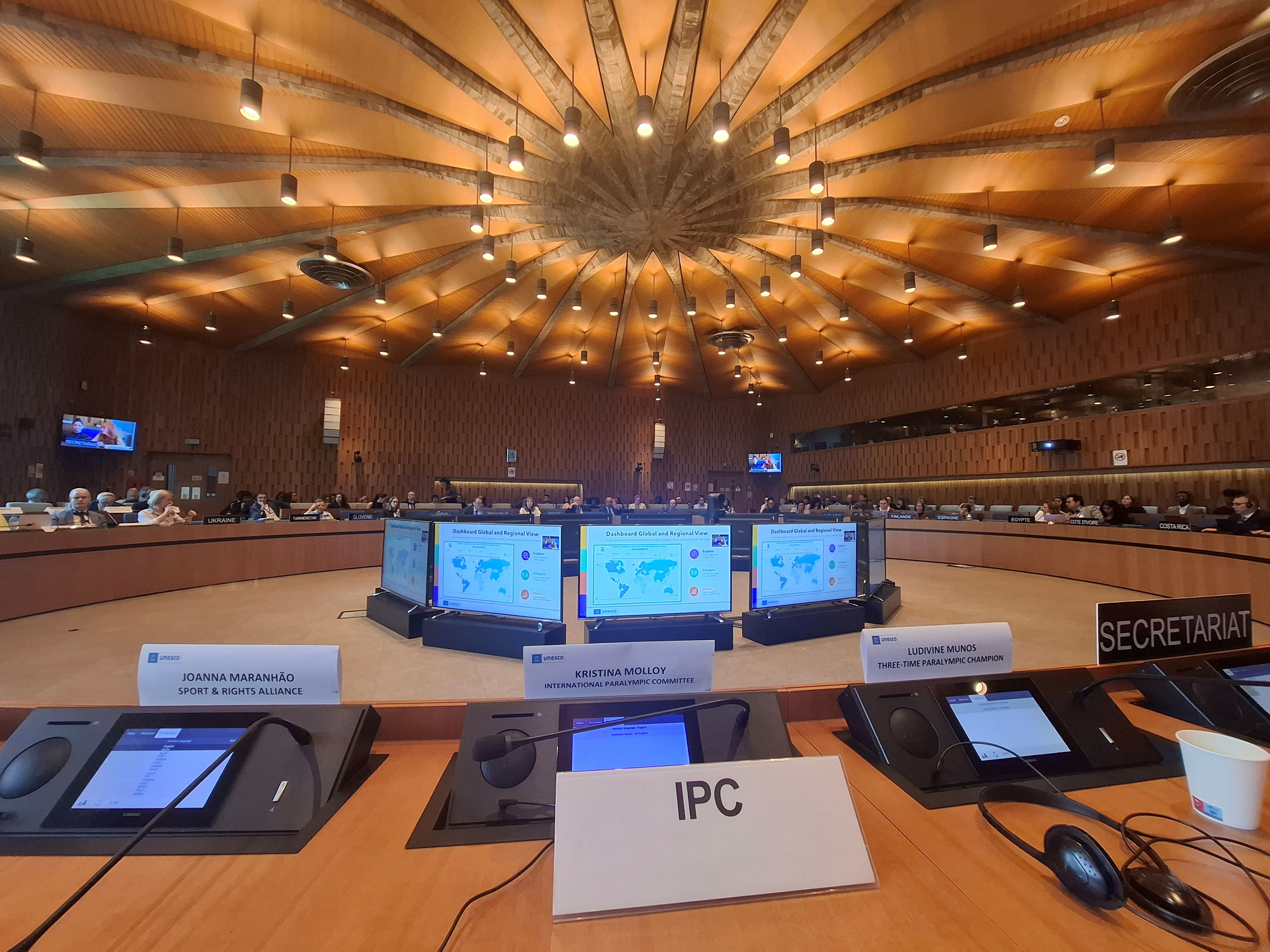
"VAN" (Sports Desk - 23.06.2026) :: The International Paralympic Committee’s (IPC) Deputy Chief Executive Officer (CEO) Kristina Molloy highlighted the power and illusion of the Paralympic Games as justification for governments to accelerate disability inclusion while speaking at UNESCO’s Intergovernmental Committee for Physical Education and Sport (CIGEPS) meeting in Paris, France, on Monday (15 June 2026).
During a session involving government representatives, UN agencies, sport organisations and non-government partners, Molloy emphasised that one of the easiest ways to drive this acceleration is through implementation of the Paris 2024 Call to Action, a roadmap for governments to follow to strengthen policies and increase investments in disability inclusion.
“If you showed up at the Paralympic Games with no other context; experienced accessible venues, a barrier-free village and the highest level of competition that shows what people with a disability can achieve when barriers are removed – you could think that life is good for people with disabilities,” explained Molloy. “And yet – when each of these athletes return home, they face barriers – to transportation, access to education, to employment… on a daily basis.
“The Games show what’s possible, but the reality is very far from it. This is where our work together comes in. This is where all stakeholders have a responsibility to lean in to make a difference.
“Two years ago, we developed the Paris Call to Action that gives a clear outline of the areas where progress needs to be made: accessible infrastructure, Para sport programming, representation, inclusive physical education and data and research. These areas, in alignment with UNESCO’s development of global policy standards – provide you and your governments with the tools for systemic change.”
To underline her point on the power of the Paralympic Games, Molloy shared how the Paralympic Games consistently deliver transformational impact.
She said: “In the UK, one million more persons with disabilities were employed four years following London 2012. In France, 1.5 billion euros were invested by the government of France in accessibility and inclusion initiatives across the country in advance of Paris 2024. In Italy, hundreds of millions of euros were invested in accessible transportation and tourism in Italy in advance of the recent Milano Cortina 2026 Paralympic Winter Games.
“These changes don’t just happen where the Games are held. We also have evidence of how the Games change perception of disability, with 73% of people who watched the Paralympic Games believing in the need to do more to drive social inclusion at all levels of society.”
According to Molloy, the IPC’s work alone cannot drive inclusion for the world’s 1.3 billion persons with disabilities, it has to be a collaborative effort. She urged governments to work closer with the expertise within their respective National Paralympic Committees and invest greater funds into the development of grassroots Para sport participation.
Molloy noted: “The IPC invests millions each year across our member countries in creating opportunities for Para sport. The reality is that these efforts will never be successful if the system itself, including sport policy and legislation, is not inclusive and specific to persons with disabilities.
“At the IPC we believe that Change Starts with Sport. Let’s tackle these changes together, and unlock an inclusive world that exists well beyond the Paralympic Games.”
The UNESCO Intergovernmental Committee for Physical Education and Sport (CIGEPS) aims to support governments to develop and implement evidence-based sport and physical education policies. The meetings are a touchpoint to assess implementation of various policy mechanisms including the Paris 2024 Call to Action.
Responses
Leave your comment