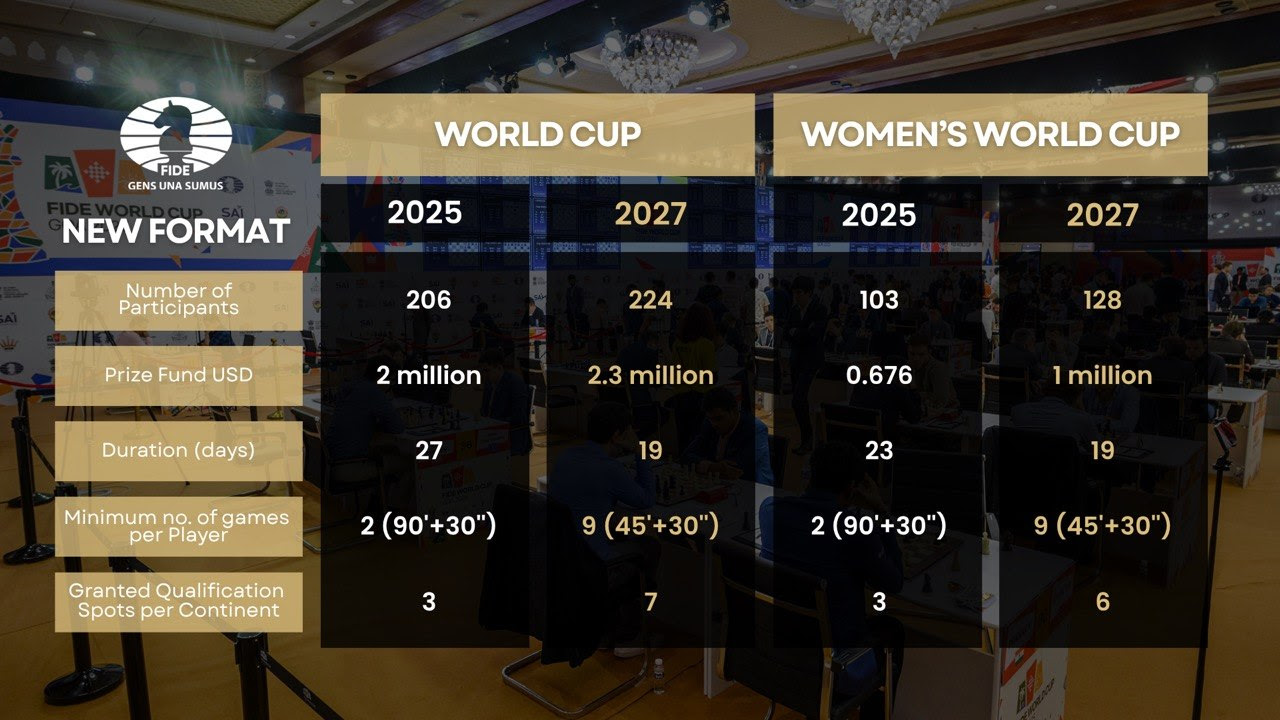
"VAN" (Sports Desk - 15.07.2026) :: The FIDE Council has approved a series of significant changes to the format of the 2027 FIDE World Cup and the 2027 FIDE Women’s World Cup, following recommendations from the Global Strategy Commission. They aim to make the competitions more inclusive, improve the experience for players, reduce the overall duration of the events, and ensure the World Cups remain one of the flagship competitions in the World Championship cycle.
Since adopting the knockout format in 2005, the FIDE World Cups have become one of the most prestigious events on the international calendar. Over the past two decades, the tournaments have expanded considerably, growing from 128 to 206 players in the Open and from 64 to 103 players in the Women’s event.
At the same time, the expansion has presented new challenges. By 2025, the Open World Cup had reached 27 days in duration, making it increasingly difficult to fit into the international chess calendar.
A new two-stage format
Beginning in 2027, both World Cups will be played over 19 days and will consist of two distinct stages.
Stage 1: Swiss qualification
The opening stage will consist of Swiss-system tournaments played with a Fast Classical time control of 45 minutes plus a 30-second increment per move.
The Open World Cup will feature four Swiss pools, while the Women’s World Cup will be divided into two Swiss pools. Each Swiss tournament will be played over nine rounds across five days, with the pools balanced to ensure comparable playing strength.
The leading players from each pool will advance to the knockout stage:
Open World Cup: Top four players from each of the four pools (16 players total)
Women’s World Cup: Top eight players from each of the two pools (16 players total)
Stage 2: Knockout finals
The second stage will retain the traditional knockout. The Round of 16, quarterfinals, semifinals, and final will be played using the existing World Cup format and classical time controls. A rest day will separate the Swiss and knockout stages, with two additional rest days scheduled during the knockout phase.
By combining a Swiss qualification stage with the traditional knockout finals, FIDE preserves the excitement and prestige of the World Cup while providing every participant with significantly more games and a better overall tournament experience.
Expanded participation
The approved format also increased the size of both competitions:
Open World Cup: from 206 to 224 players
Women’s World Cup: from 103 to 128 players
The additional places will make the tournaments even more inclusive while creating greater opportunities for players from all regions of the world.
Several new qualification pathways have also been introduced:-
- The top four finishers in the most recent FIDE Grand Swiss and FIDE Women’s Grand Swiss will qualify directly for their respective World Cups.
- The winner of the 2026 Total Chess World Championship will qualify for the World Cup.
- Qualification through the FIDE Circuit has been introduced for both the Open and Women’s World Cups.
- The number of qualification places allocated to continents has been increased to seven spots per continent, strengthening continental representation.
- A new qualification place has been introduced for the highest-rated senior player.
Responses
Leave your comment